 by admin
The Royal Stables of Córdoba (Caballerizas Reales) stand a stone’s throw from the Alcázar of the Christian Monarchs, and many people visiting the monument walk past without knowing what lies inside. This is where, in the 16th century, a project to create a Spanish horse breed took shape, on the direct orders of Philip II. Here is what they are, why they were built here and how to fit them into your visit.
What are the Royal Stables of Córdoba?
They are monumental stables built in the 16th century in the historic centre, beside the Guadalquivir, to house the finest stallions and mares of the royal stud. Their purpose went beyond keeping horses: they were part of a Crown plan to produce a unique animal, one capable of representing the monarchy.
Today the building is still linked to horses, with equestrian displays, and it remains one of the most elegant sights in the Alcázar Viejo neighbourhood. To place it, just think of the Alcázar of the Christian Monarchs: the two buildings are neighbours and share a history.
Philip II and the birth of the Andalusian horse
The royal order of 1567
On 28 November 1567, Philip II signed a royal decree formalising the standards of the breed and establishing a royal stable in Córdoba. That is why you will see two dates in the sources: 1567 for the order and the project, and 1570 for the creation of the monumental stables, the date most often repeated in tourist guides.
The king’s love of horses is part of the explanation, but not all of it. A fine horse was an instrument of political prestige in the European courts of the time, as well as a military asset.
Diego López de Haro, the king’s man
The task fell to Diego López de Haro y Sotomayor, 1st Marquis of El Carpio, a Cordoban nobleman responsible both for building the stables and for directing the selection of the animals. He is credited with the development of what we now know as the Pura Raza Española horse.
A brand with a crown
The horses bred here carried their own brand: an R for Real (royal) inside a C for Córdoba, topped with a crown. It is considered the first brand used on the earliest horses of the organised breed, a detail that shows how much this undertaking was a matter for the Crown.
Why were they built next to the Alcázar?
The location was no accident. The stables were raised on land belonging to the Alcázar precinct, a fortress that had been a key point in the city for centuries. The link with royal power went back a long way: it was Alfonso XI who promoted the Alcázar in the 14th century, and the Catholic Monarchs used it as a base of operations during the Granada campaign.
So it is no surprise that the building has a strongly military air, entirely in keeping with its neighbour.
What to see at the Royal Stables
The great hall of stalls
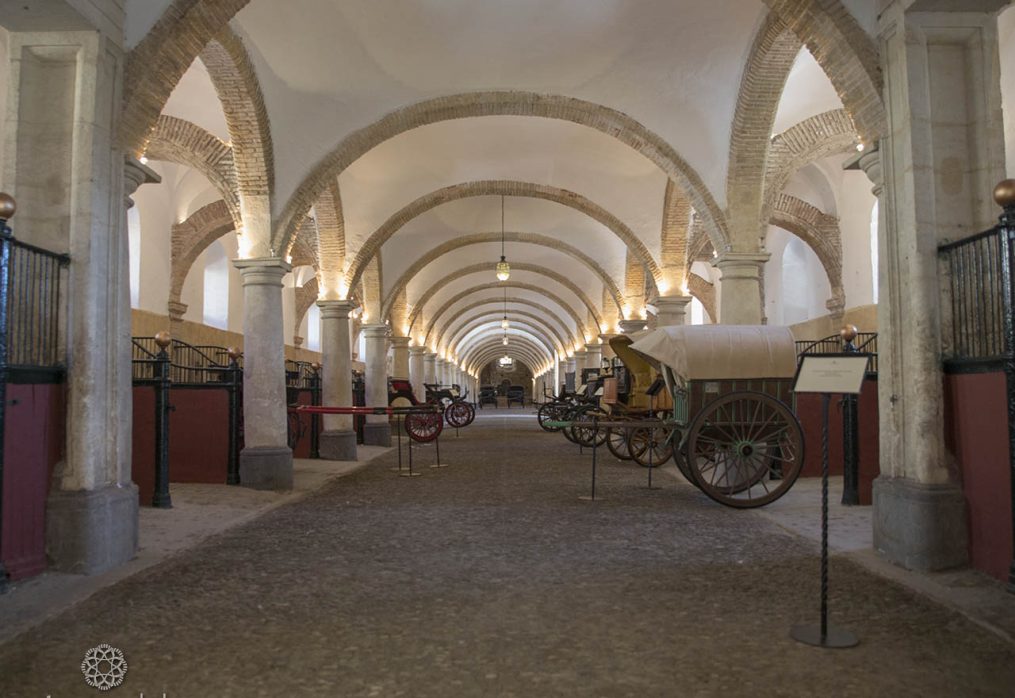
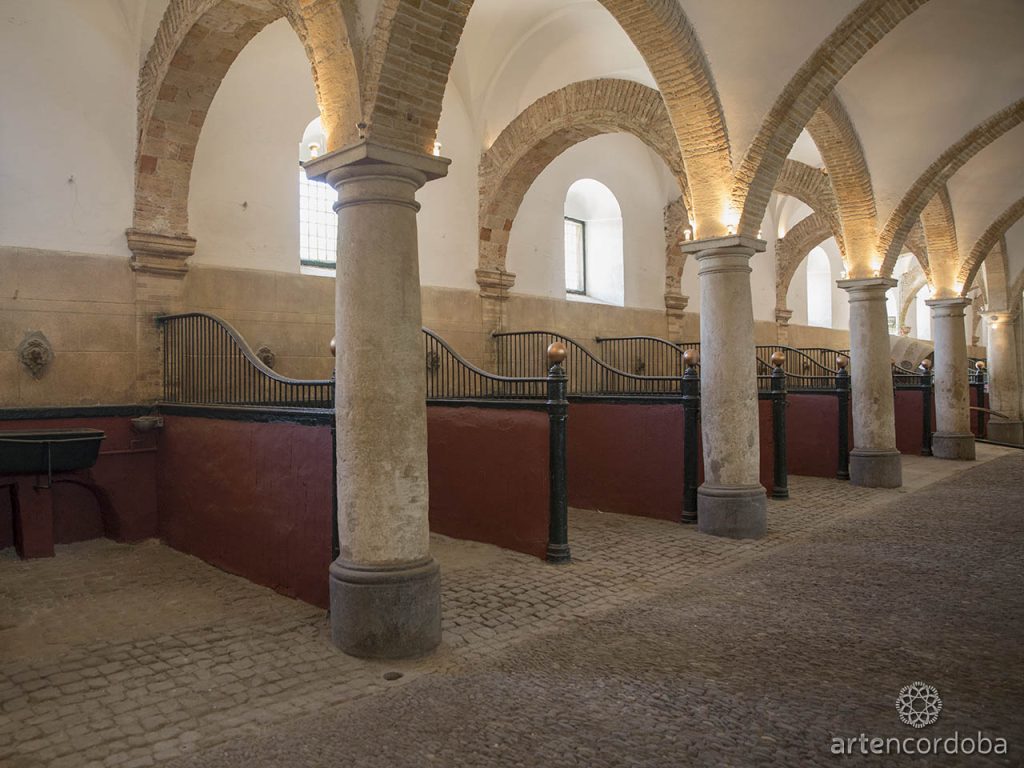
The main space is the most impressive part: a long hall covered with groin vaults, supported by sandstone columns and divided into individual stalls. It feels more like a church than a stable, and it is easy to see that the horses here were treated as a true royal treasure.
Carriages and the equestrian show
Carriages and objects related to the world of horses can be seen in the hall. The building also hosts the show “Pasión y Duende del Caballo Andaluz”, starring the Pura Raza Española horse. Days and times vary with the season, so it is best to check its official channels before planning your evening.
How to combine the Royal Stables with the Alcázar
They are so close that it is very easy to join both visits in a single morning or afternoon. Here is a good way to plan it:
- Start at the Alcázar: first read how to visit the Alcázar, with its opening times and tickets, as some areas may be affected by works.
- Enjoy the gardens: the Alcázar gardens are the best moment to slow down.
- Continue to the Stables: they are right there when you finish, and they help you imagine the life of this neighbourhood.
- End in San Basilio: its streets and patios are next door, perfect for finishing your walk.
Frequently asked questions about the Royal Stables of Córdoba
Who ordered the Royal Stables of Córdoba to be built?
King Philip II ordered them. A royal decree of November 1567 established the royal stable in Córdoba, and guides usually date the creation of the monumental complex to 1570. The commission went to Diego López de Haro y Sotomayor, 1st Marquis of El Carpio, who also directed the selection of the horses.
Where are the Royal Stables?
They are in the historic centre of Córdoba, next to the Alcázar of the Christian Monarchs and very close to the Guadalquivir, in the San Basilio or Alcázar Viejo neighbourhood. They were built on land belonging to the Alcázar precinct itself, so it is very easy to visit both monuments on the same outing.
What is their connection with the Andalusian horse?
They were the place where the breeding of the Spanish horse was organised on behalf of the Crown. The finest stallions and mares were brought together here to select a breed with defined standards, and that work led to today’s Pura Raza Española, commonly called the Andalusian horse.
Can you visit the Royal Stables of Córdoba?
Yes. The building is open to the public and hosts the equestrian show “Pasión y Duende del Caballo Andaluz”. The sources we consulted do not agree on opening times and prices, which also change with the season, so we recommend confirming them through its official channels before you go.
The Royal Stables help you understand that the Alcázar was never an isolated building, but the centre of a neighbourhood at the service of the Crown. To discover its surroundings with a guide, join our guided tour of the Alcázar of Córdoba.